
AI-Assisted Operations Need Feature Flags, Not Just Prompts
AI-assisted operations should not mean that a model gets direct authority to change production. The safer pattern is narrower and more useful: let AI collect context, explain the likely control surface, draft a recommended action, and prepare the rollback path. Keep the actual production decision in a deterministic control plane such as feature flags, with human or policy approval, audit history, telemetry, and cleanup.
That distinction matters because operations work is full of decisions that look small but change live behavior: widening a rollout, reducing an AI agent's tool access, switching a prompt profile, moving traffic to a fallback model, excluding one account segment, or activating an incident mode. AI can make those decisions easier to understand. It should not make them invisible.
This article gives platform, DevOps, SRE, and product engineering teams a practical operating model for AI-assisted operations with feature flags.
What AI-Assisted Operations Should Mean
In this context, AI-assisted operations is the use of AI to help a team understand and act on production signals. It can summarize alerts, correlate logs, compare recent flag changes, draft runbook steps, propose a rollout change, or explain why a guardrail may be failing.
The keyword is assisted. The operating system still needs clear boundaries:
| Operations job | Good AI role | Required control outside the model |
|---|---|---|
| Alert triage | Summarize signal, likely cause, and affected scope. | Observability data, incident ownership, and change history. |
| Rollout decision | Recommend continue, pause, reduce, or roll back. | Feature flag targeting, rollout percentage, approval, and audit trail. |
| AI behavior change | Identify whether prompt, model, retrieval, guardrail, or agent mode changed. | Typed runtime variation with a known fallback. |
| Production mutation | Prepare the exact operation and reverse operation. | Human or policy gate before the state change. |
| Post-incident cleanup | Find temporary flags, stale branches, and missing evidence. | Lifecycle owner, code review, and archived release decision. |
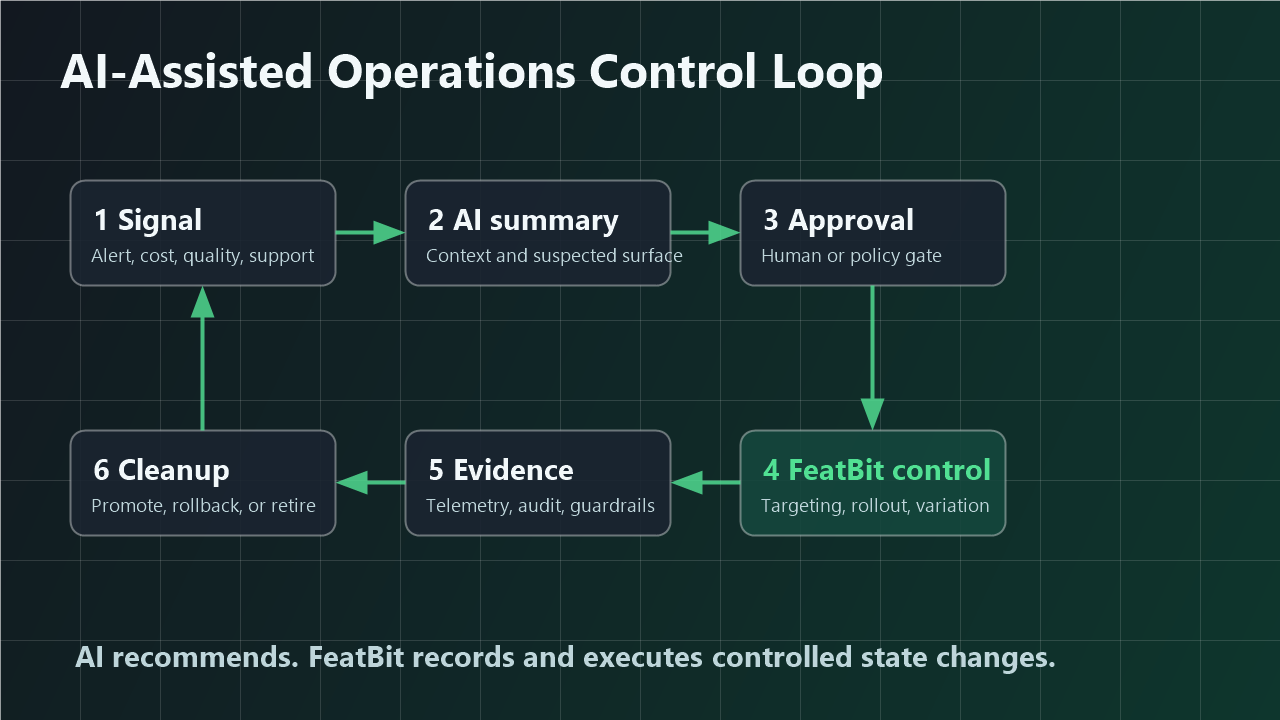
This is different from a chatbot that "runs ops." It is also different from a dashboard that only explains what happened. The useful pattern is a loop: evidence in, recommendation out, controlled action, measured result, cleanup.
Why Prompts Alone Are Not An Operations Boundary
Prompts can guide behavior, but they are weak as a production control surface. A prompt can say "only recommend safe rollout changes," but it does not provide stable targeting, typed variations, environment separation, percentage rollout, audit logs, or rollback.
The same is true for AI agent instructions. They can help an assistant behave responsibly, but they should not be the only boundary around production tools. The Model Context Protocol security guidance emphasizes consent, tool boundaries, and least privilege for agent tool use. For operations, the same idea applies: AI can participate in the workflow, but state changes need scoped access and reviewable authority.
Feature flags give the operations team a concrete control surface. They can decide:
- which users, accounts, regions, environments, or workflows receive a behavior;
- whether a candidate prompt, model, retrieval profile, or agent mode is active;
- how quickly exposure expands;
- what the fallback behavior is;
- who changed production state and when;
- which telemetry should decide the next release action.
OpenFeature's specification is useful vendor-neutral language here because it treats flag evaluation as an application decision with a key, default value, evaluation context, and related concepts such as hooks, events, tracking, and observability. For AI-assisted operations, that shape matters: the model can recommend a decision, but the application and control plane should evaluate and enforce it.
The AI-Assisted Operations Loop
AI-assisted operations works best when every recommendation travels through a repeatable loop.
| Step | What happens | FeatBit-style control |
|---|---|---|
| 1. Signal arrives | Alert, support spike, cost regression, evaluator failure, or quality review appears. | Flag insights, observability integration, webhook, or external alert. |
| 2. AI summarizes | Assistant explains recent changes, affected cohort, suspected control surface, and confidence. | Read-only access to flag state, audit history, docs, and telemetry. |
| 3. Action is proposed | Assistant drafts a narrow change and a rollback operation. | Targeting rule, variation change, rollout reduction, or kill switch plan. |
| 4. Approval happens | Human owner or policy gate accepts, edits, or rejects the action. | IAM, environment permissions, approval workflow, and audit log. |
| 5. Control changes | FeatBit changes the runtime state without redeploying the application. | Feature flag variation, segment, percentage rollout, or scheduled change. |
| 6. Evidence is checked | Operators compare the expected effect with actual telemetry. | Exposure events, guardrail metrics, flag insights, and incident notes. |
| 7. Decision closes | Team expands, pauses, rolls back, or cleans up the temporary control. | Release decision, rollback, archive, or lifecycle cleanup. |
The key property is that the AI recommendation is not the system of record. The system of record is the release-control state plus the evidence that justified it.
A Practical Example
Imagine a support assistant that recently moved from a conservative retrieval profile to a reranked profile. The new profile is enabled for 10 percent of eligible support conversations. An alert fires: p95 latency is up, and support agents are reporting more manual corrections.
A useful AI-assisted operations workflow might look like this:
operations_signal:
  workflow: support_assistant
  current_control: support_answer_profile
  active_candidate: reranker_v2
  signal:
    - p95_latency_regression
    - manual_correction_rate_up
  assistant_recommendation:
    action: reduce_rollout
    from: 10_percent
    to: internal_only
    reason: latency and correction guardrails breached for candidate cohort
    rollback_command: restore support_answer_profile to baseline for production
    evidence_gap: citation_failure_rate not joined to flag variation yet
  approval_required_from:
    - support_ai_platform_owner
    - release_manager
The assistant helps by compressing context. It should not silently execute the rollout reduction. Once approved, the flag platform applies the state change, records the audit event, and lets operators verify whether latency and correction rate recover.
This is where FeatBit's release-control view is useful. The flag is not only a switch. It is the runtime record of who saw the candidate, which fallback exists, what evidence mattered, and what should happen after the decision.
Decision Matrix For AI Assistance
Not every operations action should have the same automation posture.
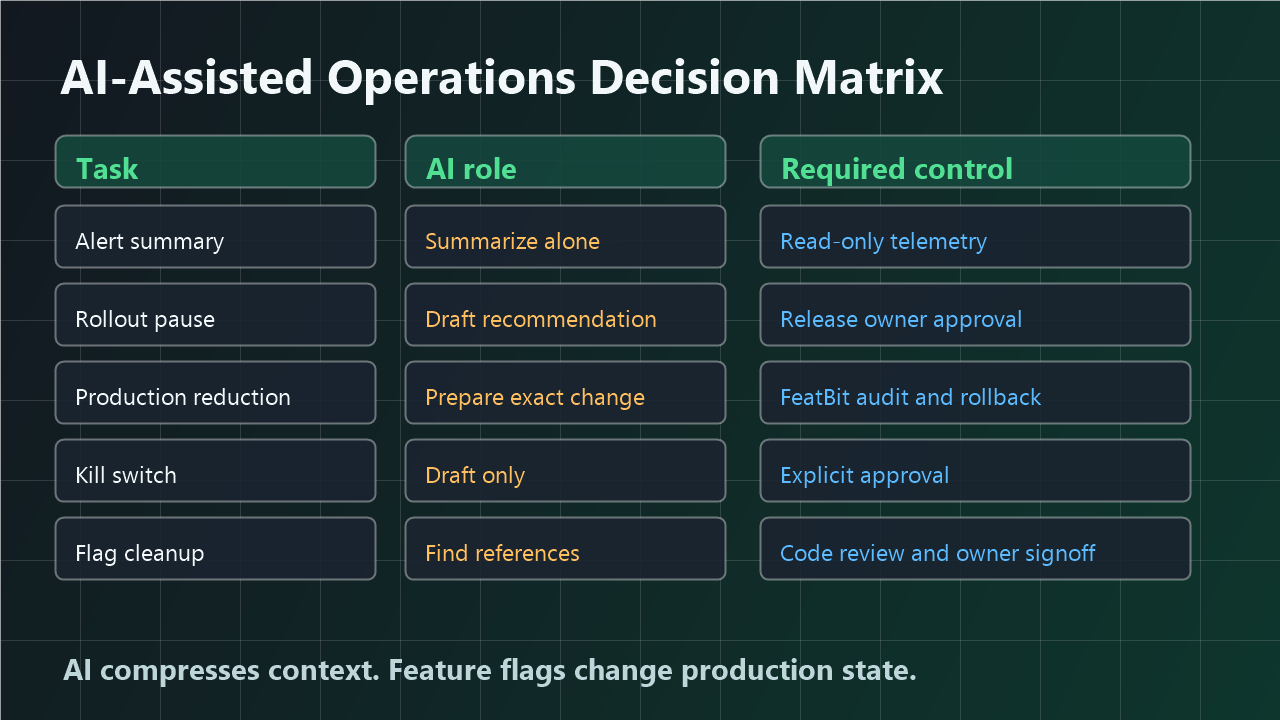
| Action | AI can do alone | AI can draft | Approval required | Never rely on prompt only |
|---|---|---|---|---|
| Summarize alerts and recent flag changes | Yes | Yes | No | No |
| Identify likely affected cohort | Yes | Yes | No | No |
| Recommend a rollout pause | No | Yes | Yes | Yes |
| Reduce rollout in production | No | Yes | Yes | Yes |
| Disable one AI agent tool | No | Yes | Yes | Yes |
| Activate a global kill switch | No | Yes | Yes | Yes |
| Change experiment metrics mid-test | No | No, except as a warning | Yes, with strong justification | Yes |
| Delete or archive a flag | No | Yes | Yes, after code-reference review | Yes |
| Change hard authorization or credentials | No | No | Security-owned workflow | Yes |
This matrix keeps the assistant valuable without turning every prompt into an operational permission model.
What Feature Flags Add To AI Operations
Feature flags are useful in AI-assisted operations because they turn recommendations into reversible release decisions.
Targeted action instead of global action
An AI assistant may notice that a problem affects one region, plan, account tier, workflow, or agent mode. A feature flag lets the team narrow the intervention to that context instead of disabling the entire feature.
FeatBit's documentation for targeting rules, user segments, and percentage rollouts covers the implementation primitives behind this pattern.
Typed runtime decisions
AI operations rarely need only a boolean on/off decision. Teams often need modes:
- baseline versus candidate prompt;
- standard versus strict guardrail;
- read-only versus approval-required agent mode;
- default versus fallback retrieval profile;
- low-cost versus high-quality model route;
- normal versus incident behavior.
FeatBit supports boolean and multivariate flags, including JSON variations. That allows the team to represent runtime modes as reviewed profiles instead of loose prompt instructions.
Audit and accountability
AI-assisted operations should make production changes easier to explain, not harder. Each change should answer:
- What signal triggered the recommendation?
- Which flag, variation, rule, or segment changed?
- Who approved it?
- Which users, accounts, or workflows were affected?
- What telemetry showed after the change?
- Was the control temporary or permanent?
FeatBit's audit log, webhooks, and flag insights help connect the operational change to the evidence trail.
Rollback without redeploying
AI can help choose a rollback action, but the rollback path should already exist. A team should be able to move a cohort back to baseline, reduce rollout percentage, activate fallback mode, or disable a risky capability without waiting for a new deployment.
That is the core reason feature flags belong in AI operations. They make production behavior adjustable while preserving a known safe path.
Where This Fits With AI Governance
AI-assisted operations is not a full AI governance program. NIST's AI Risk Management Framework describes AI risk management as a broader practice for managing risks to individuals, organizations, and society across the AI lifecycle. Feature flags do not replace that work.
They do help operationalize one part of it: controlled deployment and use. If a team cannot say who is exposed to a behavior, what changed, what signal justified the change, how rollback works, and when the temporary control ends, the operations layer is not ready for AI-assisted action.
For AI products, this is especially important because the change surface is larger than ordinary application code. Prompts, model routes, retrieval profiles, guardrails, tool policies, and agent modes can all change behavior after deployment. Each meaningful change should have a named control, an owner, a fallback, an evidence rule, and a cleanup path.
Common Failure Modes
Letting the assistant execute the first plausible action. A confident recommendation is not production approval. Require the assistant to show the affected scope, evidence, proposed state change, and reverse operation.
Using one global AI switch. A global kill switch is useful, but normal operations need narrower controls for prompt profile, model route, retrieval profile, guardrail mode, tool tier, incident mode, and rollout percentage.
Treating authorization as a flag problem. Runtime flags can decide whether an approved behavior is active. They should not replace scoped credentials, IAM, API authorization, or tool-router enforcement.
Logging assignment but not actual execution. AI systems may fall back, timeout, or route around a candidate. Operations events should record both assigned variation and actual behavior served.
Keeping temporary controls forever. Incident flags, rollback variants, and experiment candidates need owners and review dates. Some operational flags should remain permanent, but they should be documented as operational controls rather than forgotten release branches.
Starting Checklist
Before adopting AI-assisted operations, confirm:
- The assistant has read-only access before any write access.
- Production mutations require human or policy approval.
- Every AI-controlled behavior has a stable fallback.
- Flag evaluation happens where the production behavior is selected.
- Targeting uses real operational context such as account, region, plan, environment, workflow, or risk tier.
- Telemetry records the flag key, variation, assignment unit, and actual route served.
- Rollback actions are prepared before rollout expansion.
- Audit logs show tool-driven changes clearly.
- Temporary flags have owner, review date, and cleanup condition.
- Hard authorization remains separate from runtime release control.
AI-assisted operations should make operators faster at understanding production, not faster at bypassing release discipline. Use AI to compress context and draft decisions. Use feature flags to control exposure, preserve rollback, record evidence, and close the release loop.
Source Notes
- Category context: PostHog's AI engineering documentation shows how vendors are framing AI-assisted product and engineering workflows, and its feature flags documentation describes common flag use cases such as phased rollouts, kill switches, targeting, A/B testing, and remote config. This article uses those pages as market-language context, not as a product comparison.
- Vendor-neutral flag context: OpenFeature's specification is cited for typed flag evaluation concepts, evaluation context, events, tracking, and observability.
- AI risk-management context: NIST's AI Risk Management Framework is cited as a broad risk-management reference. This article applies the idea narrowly to production exposure, rollback, auditability, and cleanup.
- FeatBit implementation context: AI control layer, AI DevOps stack, safe AI deployment, AI governance, feature flag lifecycle management, targeting rules, percentage rollouts, flag insights, audit logs, and webhooks.
- Related FeatBit reading: AI-assisted flag management covers developer workflow, AI agent runtime control runbook covers live agent interventions, and AI delivery layer covers the broader architecture from AI change to production.
Image And Open Graph Notes
- Use
/images/blogs/ai-assisted-operations-feature-flags/cover.pngas the Open Graph image because it summarizes AI-assisted operations as recommendation plus deterministic release control. - Use
ai-ops-control-loop.pngnear the opening to show the loop from signal intake to cleanup. - Use
operations-decision-matrix.pngnear the decision matrix because it clarifies where AI can summarize, draft, recommend, or wait for approval.