
Manual Override for AI: The Operating Model Human-in-the-Loop Teams Actually Need
Manual override for AI is the ability for an authorized human or operations process to interrupt, narrow, redirect, or stop a live AI behavior without waiting for a redeploy. It is not only a user-interface button. It is an operating model that defines who can override the system, when the override should trigger, what safer behavior takes over, what evidence is recorded, and how the team decides whether to resume, roll back, or clean up the AI change.
The practical goal is simple: AI systems should be useful when they are working, but humans must have a prepared path to regain control before bad outputs, unsafe tool actions, cost spikes, or policy failures spread across users.

What Manual Override Means In Production
Manual override is different from general human review.
Human review usually means a person inspects an input, output, document, case, or model decision. Amazon Augmented AI and Google Cloud Document AI both document human review workflows for sending selected work to reviewers. Those workflows are valuable, but they are not the whole override problem.
Manual override answers a release-control question:
| Question | Manual override answer |
|---|---|
| What AI behavior is active right now? | A named prompt, model route, retrieval profile, tool mode, autonomy level, or fallback path. |
| Who can change it? | A named role, owner, reviewer group, incident commander, or automation with explicit authority. |
| What can they change? | Scope, audience, rollout percentage, variation, tool authority, or system availability. |
| What happens after the override? | A safer mode runs, new exposure stops, users are routed to fallback, and evidence is preserved. |
| How is the decision reviewed? | Audit logs, metrics, affected segments, reviewer identity, and cleanup state are attached to the release decision. |
This is why manual override belongs in the production control plane, not only in the model prompt. A prompt can ask the AI to defer. The control plane decides whether the AI is allowed to continue.
When An AI System Needs Override Authority
Not every AI feature needs the same override level. A low-risk summarizer can often use a simple disable switch and a human feedback queue. A tool-using agent, medical triage assistant, fraud workflow, financial recommendation system, or customer-support automation needs a more explicit authority model.
Use a manual override design when at least one of these conditions applies:
- The AI output can affect money, access, safety, permissions, legal exposure, customer commitments, or production infrastructure.
- The system can call tools, write data, submit actions, send messages, merge code, issue refunds, change configuration, or alter another system.
- The model can choose among multiple prompts, retrieval sources, model routes, or autonomy levels at runtime.
- The team needs different rules by user, account, tenant, region, environment, plan, workflow, or risk class.
- A human reviewer must be able to stop expansion even when the deployment itself is healthy.
- The organization must reconstruct who changed AI behavior, why the change was made, and which users were affected.
Regulatory and risk-management guidance points in the same direction for higher-risk systems. The EU AI Act's Article 14 describes human oversight measures for high-risk AI systems, including the ability for overseers to interpret outputs, decide not to use them, override or reverse outputs, and stop a system where appropriate. NIST's AI Risk Management Framework is broader and voluntary, but it similarly treats AI risk management as a lifecycle activity rather than a one-time model check.
The product lesson is not that every AI feature is high-risk. The lesson is that override authority should match the consequence of the behavior.
The Manual Override Mode Ladder
Many teams start with two states: AI on and AI off. That is not enough for real operations. A useful manual override model gives operators a ladder of smaller interventions.
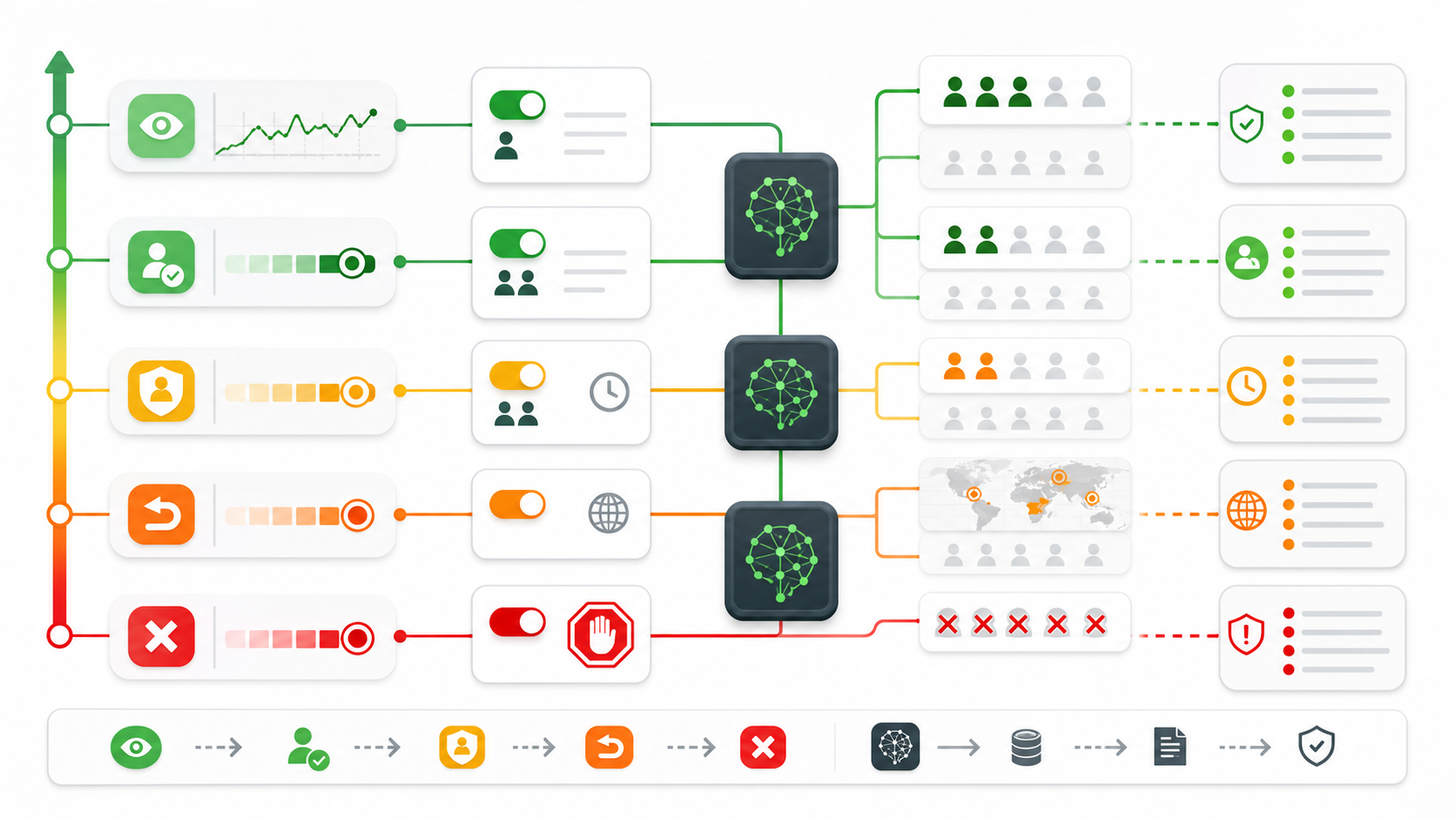
| Mode | What changes | Use when | Typical FeatBit control |
|---|---|---|---|
| Observe only | The AI can recommend, but side effects do not execute | The team is validating policy or collecting intent data | Multivariate mode flag |
| Approval required | The AI prepares an action for human review | The action is useful but consequence is material | Tool-mode or workflow flag |
| Narrowed exposure | The AI stays active for a smaller audience | The issue appears segment-specific or uncertain | Targeting rule or percentage rollout |
| Fallback mode | Users receive a safer deterministic path, older prompt, or read-only response | The AI behavior is degraded but the product should stay usable | Fallback variation |
| Targeted rollback | A prompt, model, retrieval, or tool variant returns to the previous stable state | A specific changed behavior is the likely cause | Multivariate rollback |
| Emergency stop | The AI capability is disabled for a scope or environment | Blast radius is unknown or harm is active | Operational kill switch |
The ladder matters because full shutdown is often too blunt. A support assistant with unsafe refund behavior may still be useful in search-only mode. A coding agent that should not write files may still inspect code and draft a patch. A content workflow with a high-risk segment may continue for internal users while external exposure pauses.
Manual override should move the system to the least disruptive safe state, not always to zero.
Design The Override Contract Before Launch
Manual override fails when it is improvised during an incident. Before an AI behavior reaches production, define the override contract in plain language.
manual_override:
  control_key: support_assistant_behavior_mode
  owner: support_platform
  default_mode: approval_required
  safe_fallback: search_only
  authorized_overrides:
    - support_incident_commander
    - ai_platform_on_call
    - security_operations
  trigger_signals:
    - severe_quality_review_failure
    - unsafe_tool_request
    - cost_guardrail_breach
    - policy_or_region_violation
    - telemetry_missing
  allowed_actions:
    - narrow_exposure
    - require_approval
    - switch_to_fallback
    - roll_back_variant
    - disable_capability
  audit_required:
    - previous_mode
    - new_mode
    - affected_scope
    - trigger_signal
    - operator_identity
    - review_time
This contract should be visible to engineering, product, operations, and risk owners. It should also be implementable. If the contract says "switch to fallback" but no fallback variation exists, the team has not built manual override yet.
Put The Override At The Execution Boundary
For AI systems that call tools or perform side effects, the override decision must sit at the execution boundary.
The model can propose an action. The application, tool router, policy service, or workflow engine should decide whether that action is allowed under the current override state. This prevents the most common mistake in human-in-the-loop design: treating natural-language instructions as the control mechanism.
At request time, evaluate:
- The user, account, environment, workflow, region, and agent identity.
- The requested action and risk class.
- The current override mode.
- The hard authorization boundary, such as API scope or tool permission.
- The fallback behavior if the requested action is not allowed.
- The audit event that records the decision.
FeatBit fits this layer as release-decision infrastructure. A server-side flag evaluation can return search_only, approval_required, fallback, stable_prompt, candidate_prompt, or disabled before the AI crosses the execution boundary. The application enforces the evaluated value; the model does not grant itself authority.
For the broader production pattern, see FeatBit's AI control layer, human-in-the-loop release control, and rollback strategies for AI systems.
Record Override Evidence, Not Only The Final State
An override event is a release decision. It should leave enough evidence for a later review to answer what happened.
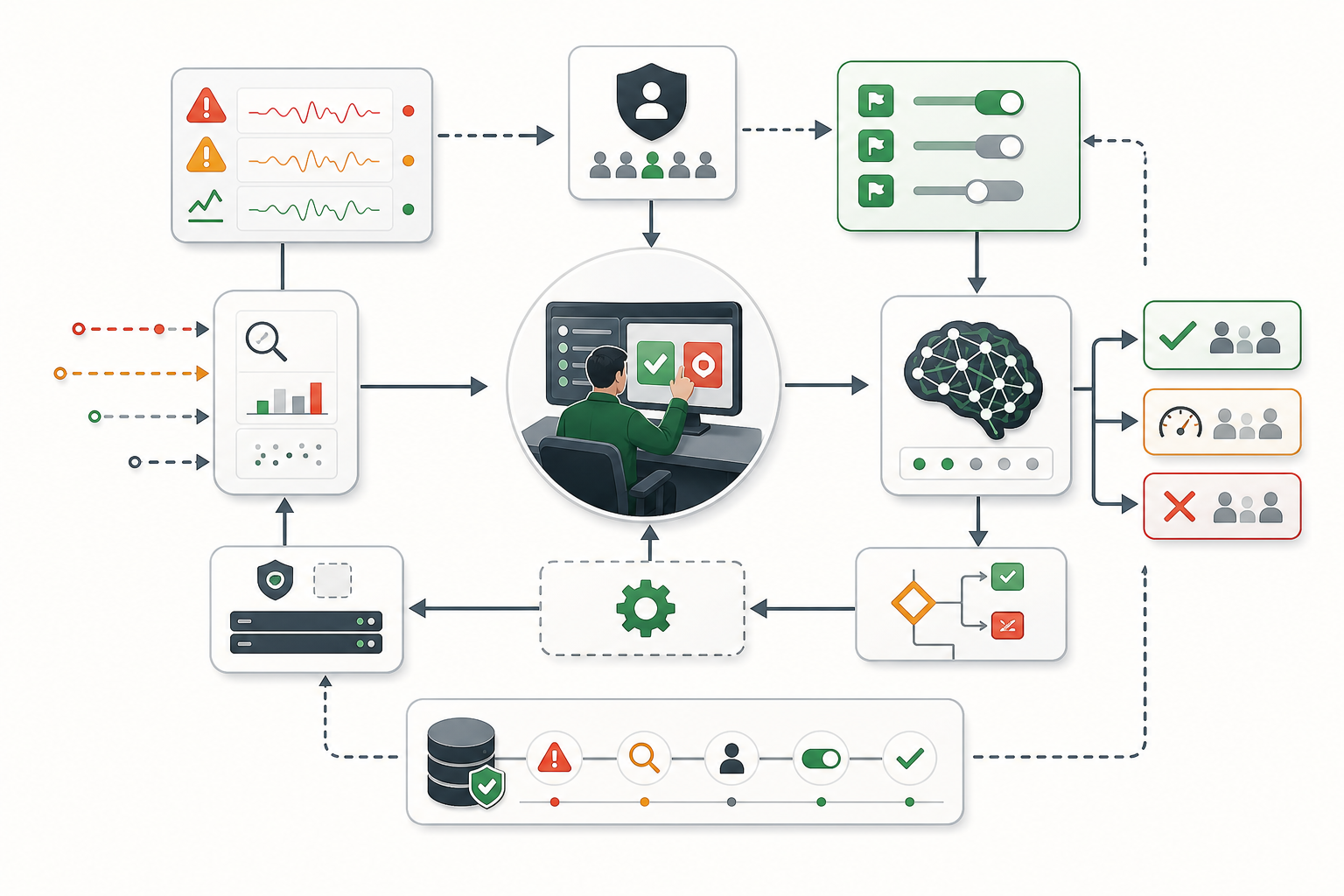
At minimum, record:
| Evidence field | Why it matters |
|---|---|
| Control key and variation | Shows which AI behavior changed. |
| Previous and new state | Distinguishes pause, fallback, rollback, and stop. |
| Affected scope | Identifies users, accounts, environments, regions, workflows, or percentages. |
| Trigger signal | Connects the override to quality, safety, cost, latency, support, or policy evidence. |
| Operator or reviewer identity | Preserves accountability for human authority. |
| Approval or escalation path | Shows whether the right role made the decision. |
| Time window and review time | Prevents temporary controls from becoming permanent without review. |
| Outcome after override | Shows whether the intervention reduced risk. |
FeatBit implementation primitives for this include targeting rules, percentage rollouts, audit logs, webhooks, OpenTelemetry integration, and feature flag lifecycle management.
The useful audit trail is not "someone turned AI off." It is "this role changed this AI behavior for this scope because this signal crossed this threshold, and the system moved to this safer state."
Manual Override Vs Human Review Queue
Human review queues are often part of an override design, but they answer a different question.
| Pattern | Primary job | Limitation |
|---|---|---|
| Human review queue | Route selected cases, outputs, or documents to people | Does not necessarily change live exposure or rollback behavior |
| Approval gate | Require a person before a specific action executes | Can become a bottleneck if every action requires approval |
| Manual override | Change live AI behavior or exposure when risk changes | Requires predefined authority, fallback, and audit paths |
| Kill switch | Stop a capability quickly | Too coarse for normal operations if it is the only control |
AWS A2I and Google Cloud Document AI human-in-the-loop workflows are useful category examples because they show that human review is often a structured workflow, not an informal chat message. For production AI release control, take the next step: connect review outcomes to runtime controls that can narrow exposure, change mode, or roll back behavior.
Common Manual Override Mistakes
Using one global AI toggle. A global toggle is useful during an emergency, but daily operations need smaller controls for prompt route, model route, retrieval source, tool authority, approval mode, and fallback.
Putting override only in the prompt. Prompt instructions can be ignored, misinterpreted, or bypassed by tool integration bugs. Enforce override state in application code and tool boundaries.
Letting the AI decide its own authority. The AI can explain why it wants to act. The system should decide whether it may act.
Skipping fallback design. If the only alternative is full shutdown, teams delay intervention. Safer fallback modes make earlier intervention easier.
Approving without context. Human reviewers need consequence, scope, evidence, and fallback. A button that says "approve action" without showing impact is not meaningful oversight.
Leaving override controls forever. Some controls are permanent operational flags. Others are temporary incident or rollout controls. Label them clearly so cleanup does not remove necessary safety controls or preserve stale rollout logic.
How FeatBit Fits The Manual Override Model
FeatBit should not be the only safety boundary for AI. Identity, API scopes, network controls, sandboxing, data permissions, and tool-specific authorization still matter.
FeatBit fits the runtime release-control layer:
- evaluate the current AI mode by user, account, environment, workflow, region, or risk segment;
- start new AI behavior with internal users, beta segments, or small rollout percentages;
- switch a live system from candidate behavior to fallback behavior without redeploying;
- preserve audit logs for flag changes and production override decisions;
- connect flag evaluations and metric events to release evidence;
- use lifecycle rules so temporary override flags get reviewed or cleaned up.
For agent-specific operations, pair this article with the runtime control runbook for AI agents and the guide to tool permissions, fallbacks, and human approval for AI agents. For governance context, continue to AI governance and risk control.
Manual Override Readiness Checklist
Before expanding an AI behavior to production, confirm:
- The AI behavior has a named owner.
- The override authority is assigned to real roles or teams.
- The safe default is defined for missing configuration or telemetry.
- The override mode ladder includes fallback, targeted rollback, and emergency stop.
- Tool and API authorization are enforced outside the model prompt.
- Reviewers see consequence, scope, evidence, and fallback before approval.
- The system records previous state, new state, affected scope, trigger signal, operator identity, and review time.
- Operators can narrow exposure by segment, account, environment, or percentage.
- Temporary controls have a review date and cleanup rule.
- Permanent operational controls are labeled so they are not mistaken for stale flags.
Manual override for AI is not a panic button added after launch. It is the control contract that makes human-in-the-loop production systems credible: prepared authority, safer modes, targeted exposure, audit evidence, and reversible release decisions.
Source Notes
- Regulatory context: the EU AI Act's Article 14 on human oversight is cited for high-risk AI oversight concepts such as interpretation, non-use, override, reversal, and stop controls. This article does not provide legal advice.
- Risk-management context: the NIST AI Risk Management Framework is cited for lifecycle risk-management framing.
- Human review workflow context: Amazon Augmented AI documentation and Google Cloud Document AI human-in-the-loop documentation are cited as examples of structured human review workflows, not as product rankings.
- Azure category context: Azure AI Foundry content filtering documentation is relevant when teams distinguish model and content safeguards from their own product-specific override contract.
- FeatBit implementation context: human-in-the-loop release control, AI control layer, AI rollback strategy, AI governance, targeting rules, audit logs, and feature flag lifecycle management.
Image And Open Graph Notes
- Use
cover.pngas the Open Graph image because it shows the article's core idea: a human override point between AI behavior and production exposure. - Use
override-modes.pngnear the mode ladder because it visualizes the move from observation to fallback, targeted rollback, and emergency stop. - Use
audit-loop.pngnear the audit evidence section because it shows override as a loop from signal to human decision to runtime change to evidence.